
You've heard of Catholic Guilt. Now get ready for First-Thanksgiving-Myth-Believing/Paper-Headdress-Wearing Guilt.
Education on respecting Indigenous cultures is improving...but I don't know if actually practicing respect is improving.

In last week’s post, I asked if we should be celebrating Thanksgiving at all because if we do, by extension, we would be celebrating the cruelty of colonists that forced their way into North America.
When I first internally debated this question of celebrating Thanksgiving, I was probably around age 23. I was living in Milwaukee, where I was surrounded by different races, ethnicities, and beliefs every day. Plus, many of the people I surrounded myself with online and in person were very passionate about calling out America’s inequalities–especially once the BLM movement of 2020 started unfolding. So when I was faced with this question about celebrating Thanksgiving, I was ashamed of how long I had been blind to the holiday’s violent past.
Just like the distasteful jokes in movies from the early 2000s, my blindness was a product of its time, as in my early education.
You've heard of Catholic Guilt. Now get ready for First-Thanksgiving-Myth-Believing/Paper-Headdress-Wearing Guilt.
When thinking about my own early education experiences, I started to fear what I’d find out about the current state of how schools teach settler colonialism and Native history.
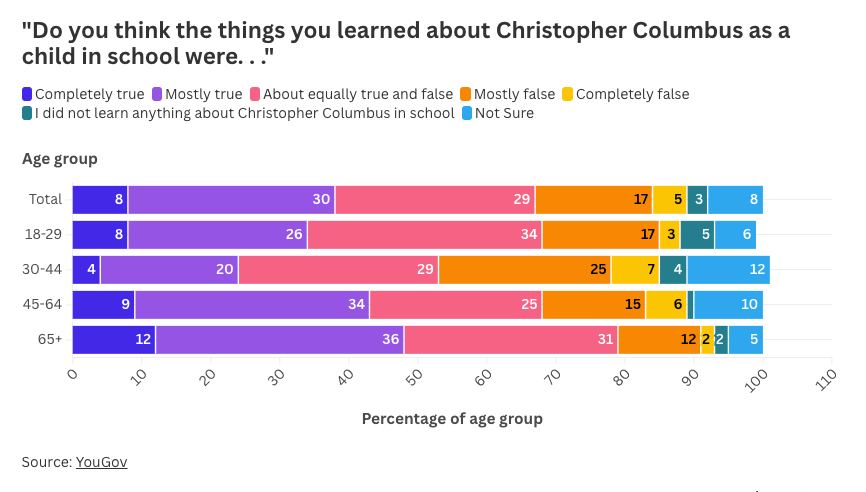
I was born and raised in a small town (like many in Wisconsin) whose name originates from an anglicized Native word and whose town and school emblem is an Indian. Throughout my school years (2002-2014), my public school taught us that Christopher Columbus was the discoverer of the Americas and the Wampanoag celebrated the “First Thanksgiving” with the Pilgrims–and in grade school we celebrated that by fashioning our own paper headdresses and wearing them to a lunchtime feast of turkey slices and pumpkin pie squares. Luckily, in my time at school, I remember this re-enactment happening only a couple of years.
We learned a false narrative that glorifies colonialism, erases Native voices, and hence enforces ethnocentrism. All while proudly using Native imagery in our school and town.
Was this education decision out of fear that the truth would splinter our pride in America? Or was it something else?
And was the lie worth losing our trust?
Signs of Progress (1977 to 2021)
I wonder now: how were these myths upheld for so long? Particularly in a town that openly acknowledges its connection to Native Americans, in a state that is home to one of the largest number of Native American Tribes east of the Mississippi River.
Among the reasons it seems we should have learned a less biased history:
Indigenous delegates from around the world came together at a monumental United Nations Conference in 1977 (19 YEARS BEFORE I WAS BORN, 25 YEARS BEFORE I STARTED ATTENDING SCHOOL) and proclaimed October 12, "the day of so-called ‘discovery’ of America, as an international day of solidarity with the Indigenous peoples of the Americas."
In 1989, Wisconsin passed "a law that required schools to teach about Native American history, culture and tribal sovereignty" called Act 31. However, as of 2023, there's nothing in place to actually enforce that law.
The book Rethinking Columbus was published in 1991, and according to some sources, became quite popular. It was co-edited by education activist (and now former member of the Milwaukee Board of School Directors in Wisconsin) Bob Peterson.
The public school I attended in Northeastern Wisconsin was in communication with the town's namesake tribe and (at least once in my memory) brought in tribal members to answer questions from students (the only one I can remember is a young boy asking if they had TV); Additionally, the tribal members gave the town and school permission to continue using its Indian mascot, though the last time that was confirmed was 2005 and the town's Indian mascot emblem dons the historically correct headdress whereas the school's Indian mascot is stereotypically costumed in a headdress that resembles those of the great plains tribes.
My hometown erected a historical marker that acknowledges the colonial history of the town. "The marker explains how the group of Potawatomi people were forcibly removed from their village and planting grounds known as Black Earth by the Kewaunee County sheriff and his posse because of unpaid property taxes." However, the project seemed to be spearheaded by only one guy…so I'm not sure how closely his conviction on reparations mirrors other townspeople's.
Several states and cities officially adopted Indigenous Peoples Day between 1990 and 2017 including South Dakota, Alaska, Oregon, and Berkeley, California who also just this year returned sacred land to the tribe it belonged to. Governor Tony Evers added Wisconsin to the list in 2019, and Joe Biden was the first president to issue a proclamation to honor it as a federally-recognized holiday in 2021 (but unfortunately rather than observe it in place of Columbus Day, stated they should both be celebrated on the same day).
With this level of local and public awareness dating back to 1977, it's still shocking that the curriculum was not corrected before I even entered Kindergarten. I can't be the only one who felt disillusioned upon learning the truth about Columbus, and subsequently distrustful of schools/teachers/authority.
First Santa Claus, then Christopher Columbus…how many more glorifying lies about White guys can a girl take? (hint: there’s plenty more where that came from)
The Current State of Columbus and Indigenous Education Across the Nation
Luckily, teaching the real story of Columbus and incorporating Native history has become increasingly common in schools across the nation. For example, the Washington State Board of Education noted a jump in the number of school districts that teach tribal history and culture from 44% in 2021/2022 to almost 90% in 2022/2023.
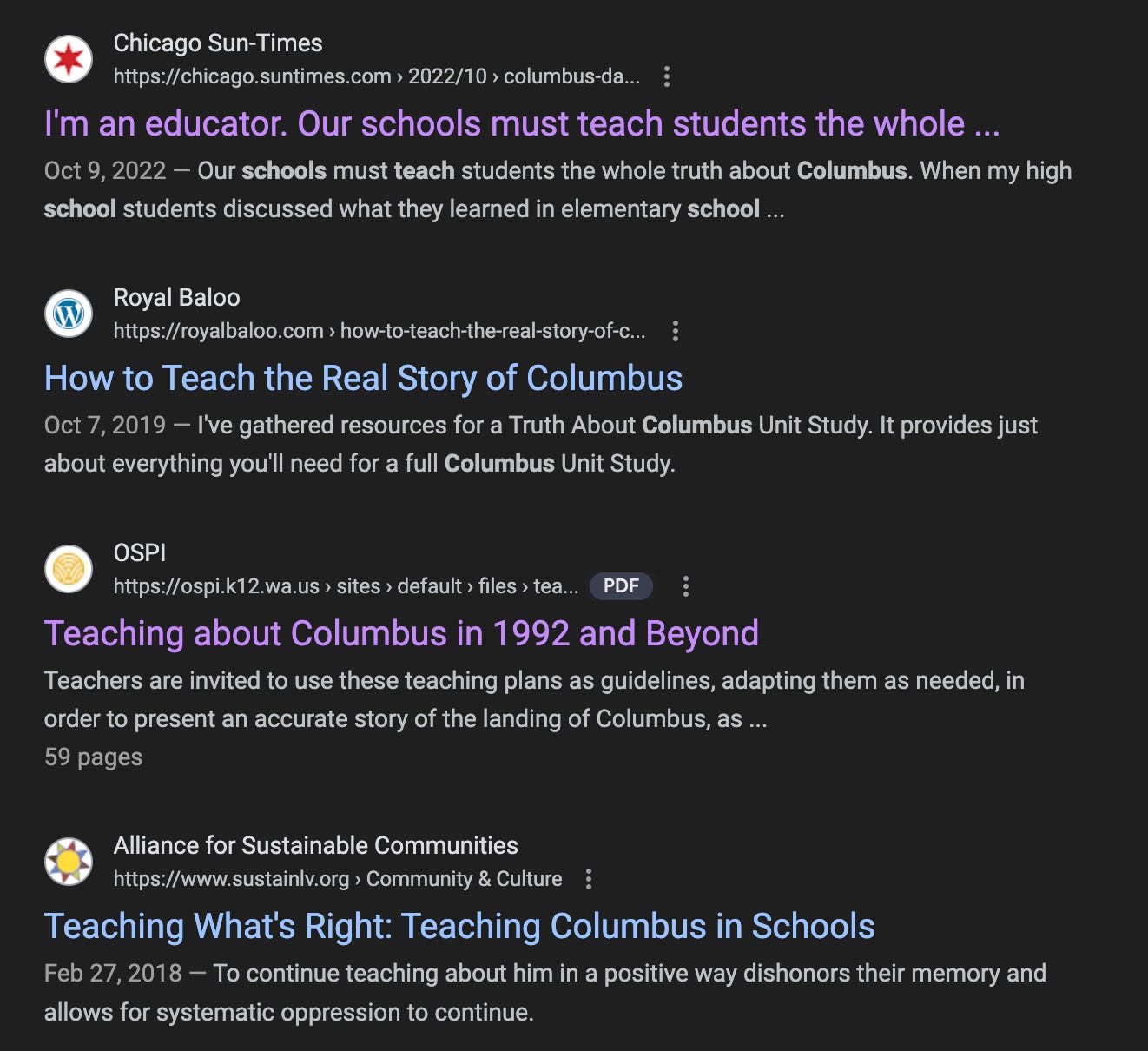
While Columbus Day is still recognized at the federal level, local districts have the power to decide to fully replace Columbus Day with Indigenous Peoples' Day, like Milwaukee did in 2021 and many other districts had done before that.
Of course, there are those individuals and organizations like the Young America’s Foundation mentioned above that share their fears that “The Left is making considerable progress on its long-standing mission to tarnish the image of Christopher Columbus and erase his legacy from history.” While it’s true that Columbus statues have been removed/destroyed by force throughout the country, Columbus will not soon be forgotten.

By conflating pride in Christopher Columbus with pride in America, they’re missing the point that Columbus is not being removed from our history books. Instead, educators are working to fully display his actions–the good and the bad– for kids and adults to work to parse the past from multiple perspectives, as historians do. Those not worth celebrating are still worth learning about.
As Leah Shafer and Bari Walsh write in “The Columbus Day Problem”:
“we want to students to engage with controversy. That’s when learning happens.”
And as David Silverman shares in an interview with Claire Bugos:
“If we're taught to cut through colonial rhetoric we'll be better positioned to cut through modern colonial and imperial rhetoric.”
An Update on Indigenous Emblems
While public scrutiny of and state laws against Indigenous-related names and logos prompted several national sports teams to change their names, nearly 2,000 schools still use Native mascots, including almost 30 school districts in Wisconsin retain their Native American names and/or mascots. My hometown school is one of them. In 2023, tribal leaders from across the country even wrote letters to Wisconsin schools asking them to retire their Indigenous mascots:
“The intolerance and harm promoted by these mascots, logos, and associated fan behaviors and school traditions perpetuate negative stereotypes and contribute to a disregard for the personhood of America’s first peoples.”
From these 2013 public hearing documents, it seems that one of the main reasons why my and other high schools in Wisconsin haven't ceded this request is because of Wisconsin’s Act 115, which requires 10% of a school’s students to sign a complaint about the Indigenous imagery. Those community members in favor of maintaining their team mascots of “Indians,” “Redmen,” “Chieftains,” and otherwise cite “pride” in their names and logos. But is their pride in their team or the stereotyped branding they’ve built around them?
This leads to an important lesson I’ll say a little more about in my conclusion, but I’ll also say it now: Use your voice to speak up for others. The community I grew up in is majority white, and so there are very few Native Americans to speak against the use of Indigenous mascots by the community. The same is likely true for many of the school districts still using Indigenous-based mascots listed here. Each of us needs to listen to those hurt or oppressed by an action in order to decide our own subsequent actions. And in this case, it could be as easy as signing a petition to change the mascot (a few here on Change.org).
Next Steps
Overall, it’s great to learn that honoring and learning about Native history and diverse perspectives is on the rise across the nation. However, even while institutions and governments are making proclamations and laws that support these efforts, conservative parents are making it very difficult for teachers to take this progressive path. As Hannah Natanson writes in “Trust in teachers is plunging amid a culture war in education,” describing parents’ reactions to what their kids’ were learning in their virtual schooling in 2020:
“Many parents soon discovered they did not like what they saw, deeming the lessons overly focused on issues of race, racism, topics such as gender fluidity and gender identity, and the parts of U.S. history in which the country failed to live up to its ideals, said Rick Hess, director of education policy studies for the conservative-leaning American Enterprise Institute.”
So while I used to be worried about kids being negatively affected by culturally-incomprehensive school curriculums, I’m now worried about the adults convinced that including other perspectives in children’s education is equal to indoctrination.
Getting individuals to understand, empathize, and adopt an anti-discriminatory mindset is still a barrier, and one that will be difficult to overcome with the political division of today’s world. We can’t sit around and blame institutions anymore. Now, the ball is in each of our courts to help achieve progress.
The framework for a more equal world is being built up around us a little more each day–through curriculums, proclamations, laws, literature, and entertainment. And it’s up to each of us to learn about other cultures and perspectives, uplifting oppressed voices, and actively and openly confront inequality in our everyday lives in order to achieve greater progress.
Related Book Recommendations!
All the Real Indians Died Off: And 20 Other Myths about Native Americans by Roxanne Dunbar-Ortiz and Dina Gilio-Whitaker
This Land Is Their Land: the Wampanoag Indians, Plymouth Colony, and the Troubled History of Thanksgiving by David Silverman
Buy the books I recommend on Substack from my Bookshop.org affiliate link: https://bookshop.org/lists/substack-recs-gabbi-sees
Land Acknowledgment
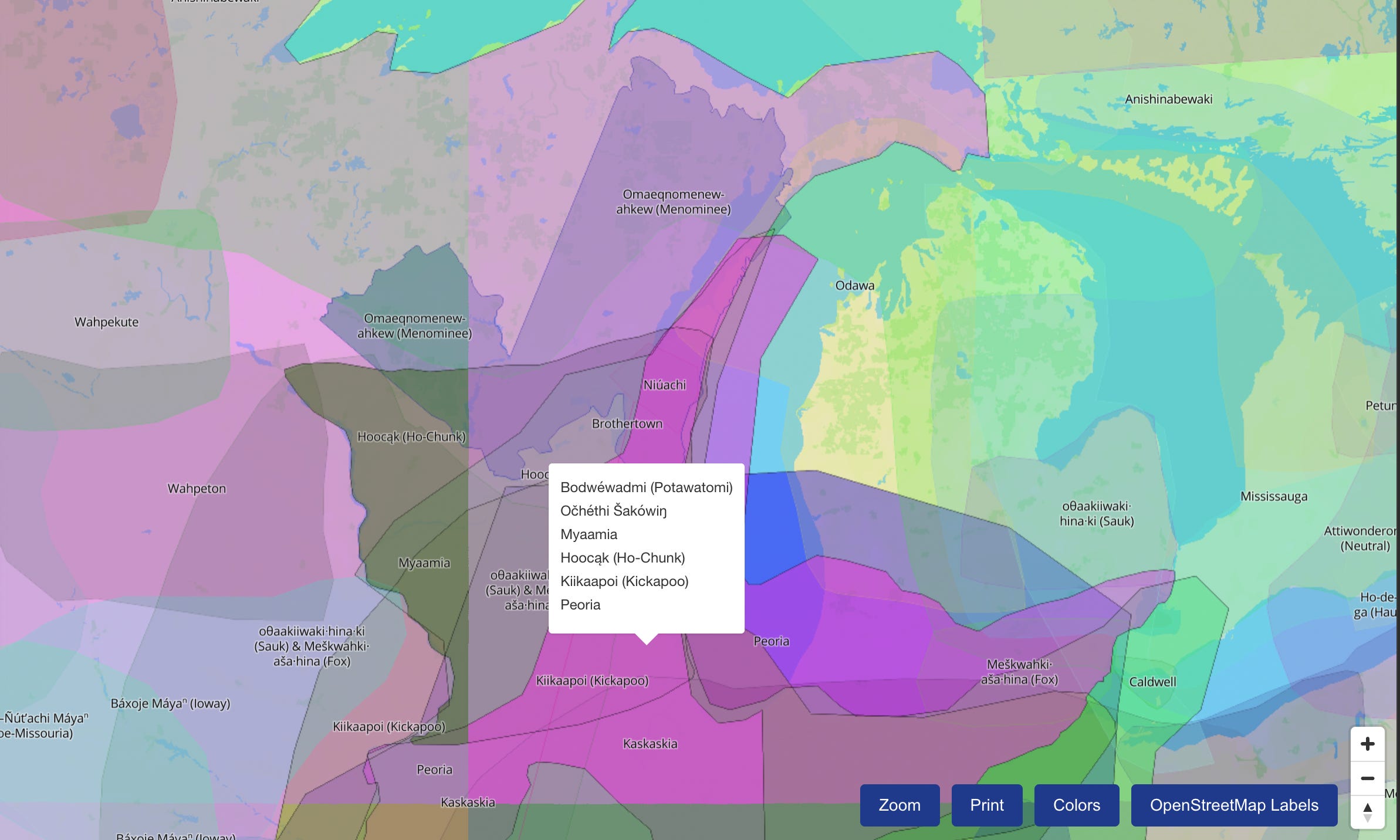
Milwaukee, “the gathering place by the waters,” is on traditional Potawatomi, Ho-Chunk and Menominee homeland along the southwest shores of Michigami, North America’s largest system of freshwater lakes, where the Milwaukee, Menominee and Kinnickinnic rivers meet. The largest concentration of Native Peoples statewide reside in Milwaukee. Celebrate and support them today.
I’d like to know:
Have any other book recommendations on this topic?
Want me to write about anything in particular? Or perhaps you have a vague topic you’d like to offer as a prompt? I’ll take anything.